

-
History
-
In July 2013 we launched the OpenScience Laboratory as an innovative online platform for practical science. In partnership with The Wolfson Foundation, we engaged our excellent teachers, leading researchers and software developers in the creation and evaluation of authentic and effective online practical enquiries; commercial software enterprises were also engaged. Our intention was to transform the experience of learning practical science. The OpenScience Laboratory later expanded into the OpenSTEM Labs as the growth of lab activities called for distinct categorisation within several sub-labs.
The challenge: teaching practical STEM at a distance
By creating the OpenSTEM Labs as “an Internet of Laboratory Things” we realised our vision for inclusive and accessible facilities for practical work in the OU’s distance-learning setting. This initiative built on our pioneering OpenScience Laboratory, placing an emphasis on real-time access to labs and observatories. The OpenSTEM Labs concept connected students to state-of-the-art instrumentation for practical enquiries over the internet – distance no object and open all hours. Constructed in a blend of real and virtual space, the labs achieve greater accessibility and higher efficiency than possible in a conventional co-location of students, teachers and equipment.
The OpenSTEM Labs provide a modern platform for practical skills in STEM: real data, authentic interfaces, real-time. The main spending-window for the project was the 15/16 academic year. The infrastructural facilities were completed and a large amount of the new equipment was commissioned. The OpenSTEM labs consequently won the Times Higher Education Leadership & Management Award (THELMA) 2017 for Outstanding Digital Innovation.
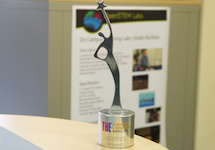 The THELMA trophy, won in 2017 (see Awards)
Innovative technologies and approach
Our strategy exploited the ubiquity of web-browsers, the versatility of HTML5, the speed of light and imaginative approaches to minimising latency in networks. Students were now able to connect remotely to various technical equipment such as microscopes, a robotic-rover, and telescopes, engaging with a range of environments from analytical labs to a Mars-analogue landscape. Thousands of student-hours of use have been logged in our curriculum.
Leading edge practices
For over half a century The Open University (OU) has championed the application of technology to enhance learning. For presentation of supplementary material we have evolved from late night TV, video cassettes, CDs and DVDs to the internet. During this time practical work for OU students has become more difficult owing to restrictions on what can be safely sent out in home-experiment-kits and restricted opportunities for face-to-face classes in a true distance learning model. The next step was to bring practical work up-to-date so that the sophistication of modern teaching labs became routinely available online. This also allowed time and space for a more inclusive approach to lab-work.
Overcoming cultural, financial and other barriers to success
This project aligned with the OU’s mission of openness but colleagues were initially sceptical of the practicality of online practical work. It took many years of pilots and demonstrators to gain their confidence. A significant enabler was HEFCE’s £2.8m STEM-Capital grant (matched by OU). The delivery challenges for the OpenSTEM Labs related to engaging multiple stakeholders with disruptive innovation. It was essential to ensure compatibility with existing campus infrastructure, curriculum delivery models and IT requirements, while giving students the best possible user-experience.
Developing scalable innovations
The OpenSTEM Labs were designed to be reconfigurable for specific audiences and to be expandable. Our development plan included partnerships with HEIs and other third parties sharing online activities. This is how we planned to grow and diversify our “Internet of Laboratory Things”.
-