

-
Learn about the individual labs, see how the auto-titrator is set up, watch the windtunnels in action and find out how the gas cell experiment was developed and works. Our OpenSTEM Labs playlist will give you an insight into the physical equipment behind the online activities.
-

Find out how to access activities, particularly as a non-student guest visitor.
-
View a selection of the experiments that are available to students, using real, remotely controlled equipment.
About the OpenSTEM Labs
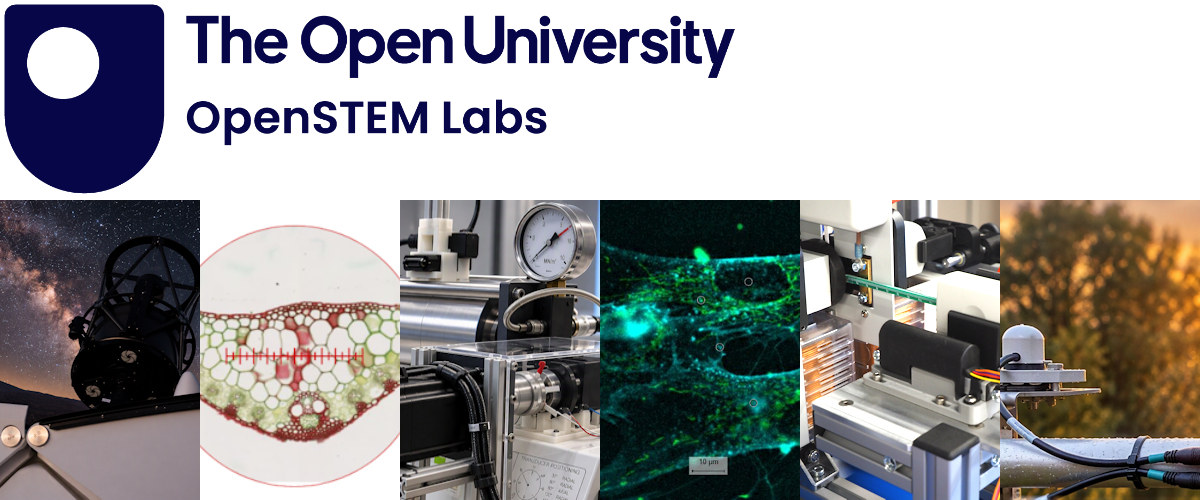
The OpenSTEM Labs (OSL) challenge the traditional university model of students and teachers being co‑located in a lab, during office hours. The OSL are an integral component of The Open University’s distance learning environment. There are over 200 activities within the OSL and these are used on over 50 OU modules.
Distance is not a barrier and access to equipment can be available 24 hours a day. Remote experiments allow students and teachers to access equipment via a web browser. They can book an online session, undertake the experiment/activity, send real‑time control commands, monitor real-time performance and download data for subsequent analysis.
Interactive screen experiments utilise large data sets in a simulated environment. They enable students to access data in an engaging format that often replicates the original data extraction method. The methodical processes turn tables of information into relatable learning experiences. These activities have no time limits and can support multiple students at any point.
OpenSTEM Labs Core values
- Inclusivity: accessible at any time from any place by anyone.
- Pedagogy: individual and group working is enabled in the context of student-led or tutor‑led enquiries that are interactive and collaborative.
- Veracity: real data from real equipment in real‑time
- Authenticity: the labs feature bespoke teaching tools, industrial grade equipment and research grade instruments, each in their home environment
Facilities (2026)
The following facilities form the real‑time interactive ‘hands‑on’ parts of the OpenSTEM Labs:
- 100 workstations for experiments in electronics and control
- analytical chemistry instruments including auto-titrators, UV-visible spectrophotometers and an NMR
- Scanning Electron Microscopes (SEM)
- optical microscopes
- optical telescopes at the Instituto de Astrofisica de Canarias on Tenerife
- weather stations in Milton Keynes and Tenerife
- an enclosed ‘Mars landscape’ and remote-controlled, multi-user, imitation Mars rover
- particle detector cameras
- x-ray apparatus (investigating Compton and Bragg scattering)
- teaching wind tunnels
- live cell culture microscopy
- bespoke equipment investigating planetary gases, the Hall effect, perfect gas law, strain, creep and many more.
....with further instruments and activities being brought online regularly.
You are not signed in to this website. More facilities might be available if you sign in.